
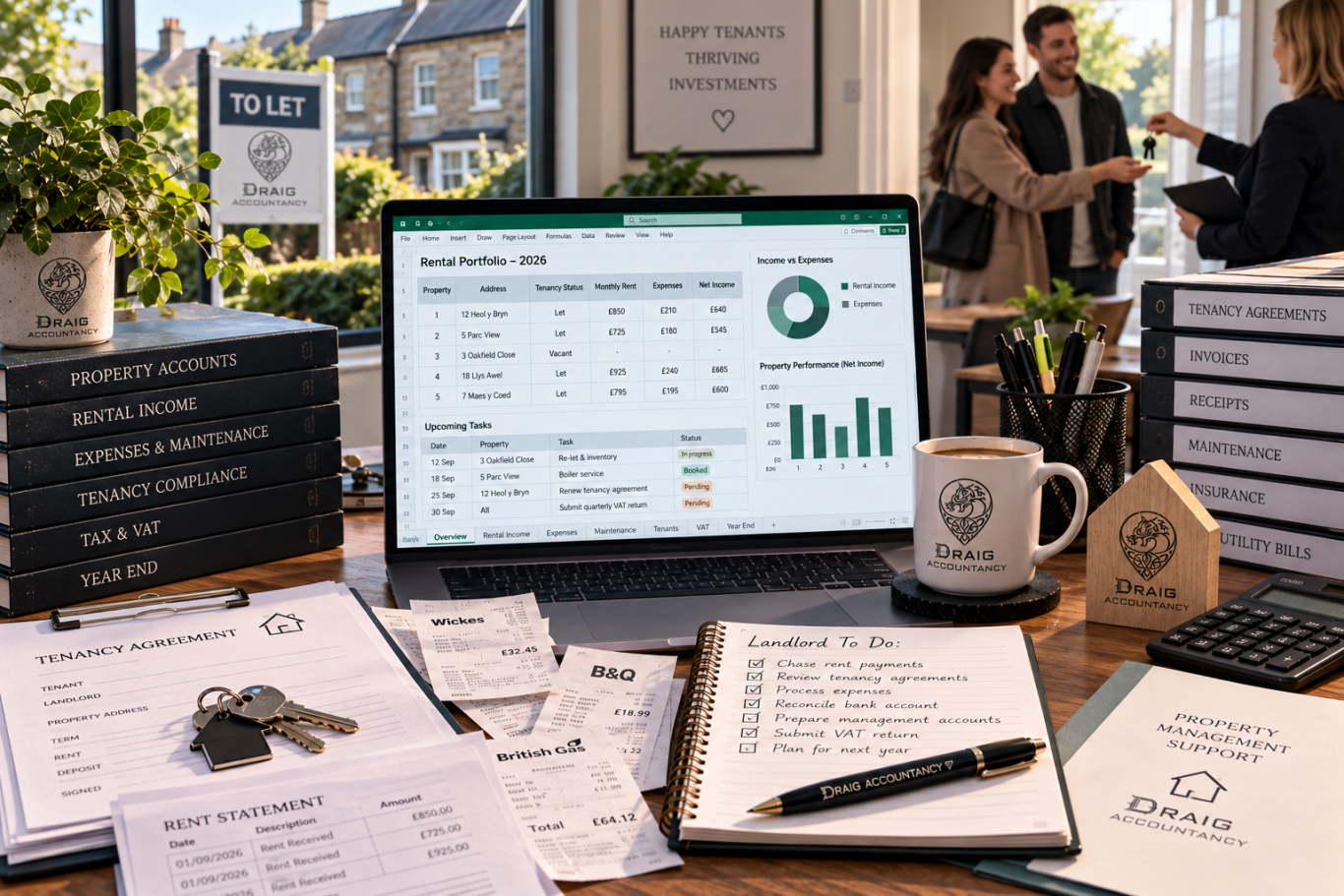
Landlord Tax Returns & Property Income
Helping Landlords Understand Their Tax Responsibilities with Confidence
Owning a rental property can provide valuable income, but it also brings tax and record-keeping responsibilities that are easy to overlook.
Whether you have purchased a buy-to-let property, inherited a house, started renting out a former home or built a growing property portfolio, it is important to understand what needs to be declared, what records to keep and how the income should be reported to HMRC.
Draig Accountancy provides practical tax and accountancy support for landlords across Ammanford, Carmarthenshire and the wider UK.
Based in Penygroes, near Ammanford and Cross Hands, I work with landlords locally throughout Carmarthenshire and remotely across Wales and the UK.
Whether you are declaring rental income for the first time or already manage several properties, I can help make the financial side of property ownership clearer and easier to manage.
Property tax does not have to feel complicated
Many landlords contact me because they are unsure what HMRC expects from them.
Common concerns include:
- whether rental income needs to be declared
- whether a Self Assessment tax return is required
- what expenses can be claimed
- how much tax may be due
- how mortgage interest is treated
- how repairs and improvements are treated differently
- whether previous rental income has been reported correctly
- what records need to be kept
- what Making Tax Digital means for them
- what happens when a rental property is sold
- what to do after receiving correspondence from HMRC
Property income can also become more complicated when it sits alongside employment income, self-employment, dividends, pensions or other sources of income.
My role is to explain what applies to your circumstances, help you keep the right records and make sure the relevant information is reported correctly.
First-time or accidental landlord?
Not everyone sets out to become a landlord.
You may have:
- moved home and decided to rent out your previous property
- inherited a property
- moved in with a partner and retained your own home
- purchased your first buy-to-let
- started letting part of your property
- begun receiving property income unexpectedly
If rental income is new to you, it can be difficult to know where to start.
I can help you understand what needs to be reported, which records to keep, what expenses may be relevant and what your next deadlines are.
You do not need to have everything perfectly organised before getting in touch.
Who I work with
I support:
- first-time landlords
- accidental landlords
- buy-to-let investors
- individuals renting out a former home
- landlords with several properties
- jointly owned rental properties
- individuals with property income alongside employment or self-employment
- property owners who need help bringing previous years up to date
Whether you own one rental property or a growing portfolio, the level of support can be tailored to your circumstances.
How I can help
Landlord Self Assessment tax returns
Preparation and submission of Self Assessment returns including rental income and relevant property information.
Rental income reporting
Making sure property income is recorded and reported correctly.
Allowable property expenses
Guidance on which costs may be deductible and how expenses should be recorded.
Property record keeping
Helping you organise rental income, expenses and supporting documentation so your records are clear and complete.
First-time landlord support
Practical guidance if you have only recently started receiving rental income.
Jointly owned properties
Help with understanding how rental income should be reported where a property is owned jointly.
Making Tax Digital
Support with digital record keeping and compatible software where Making Tax Digital for Income Tax applies.
HMRC support
With the appropriate authorisation in place, I can assist with property-related HMRC correspondence and queries.
Ongoing tax support
Support as your circumstances change, for example if you buy another property, sell a property, change ownership or your wider income changes.
What expenses can landlords claim?
This is one of the most common questions landlords ask.
Depending on the property and circumstances, deductible costs may include items such as:
- letting agent and management fees
- landlord insurance
- repairs and maintenance
- accountancy fees relating to the property business
- utilities and council tax paid by the landlord
- certain legal and professional costs
- replacement of certain domestic items
- other costs incurred wholly and exclusively for the property business
The tax treatment of finance costs, improvements and capital expenditure can be different from ordinary running expenses, so it is important not to assume every cost is treated in the same way.
I can help you understand how expenditure should be recorded and whether it is likely to be deductible against rental income or treated differently for tax purposes.
Repairs or improvements?
This is another area that often causes confusion.
Repairing or replacing something to restore a property to its previous condition may be treated differently from making a significant improvement.
That distinction can affect whether expenditure is deductible against rental income or may instead become relevant when calculating a future capital gain.
Keeping clear invoices and records for substantial property expenditure can therefore be important long after the work has been completed.
Mortgage interest and finance costs
For individual residential landlords, mortgage interest is subject to specific tax rules and is not generally deducted in the same way as an ordinary property expense.
This can make the tax calculation less intuitive, particularly where there are several properties or other sources of income.
I can explain how finance costs affect your tax position and make sure the relevant information is reported correctly.
Making Tax Digital for landlords
Making Tax Digital for Income Tax is now being introduced in stages for sole traders and landlords.
From 6 April 2026, individuals with qualifying self-employment and property income over £50,000 are required to use MTD for Income Tax, subject to the relevant rules and exemptions. The threshold falls to over £30,000 from April 2027 and over £20,000 from April 2028. Qualifying income is based on gross self-employment and property income before expenses.
Those within scope need compatible software to keep digital records and send quarterly updates to HMRC as part of the new system.
I can help you:
- understand whether and when MTD applies to you
- choose suitable software
- move from manual records or spreadsheets where appropriate
- keep digital property records organised
- prepare for quarterly reporting
- make sure your systems remain practical and manageable
For landlords approaching the thresholds, planning ahead can make the transition much easier.
Buying, selling or changing your property portfolio
Landlord tax does not only arise while you are receiving rental income.
You may also need to think about tax when:
- purchasing another rental property
- selling a property
- transferring ownership
- changing from sole to joint ownership
- inheriting property
- carrying out substantial improvements
- considering moving a property into or out of a company
- restructuring a wider property portfolio
These decisions can have Income Tax, Capital Gains Tax, Stamp Duty Land Tax and legal implications, depending on the circumstances.
Where a transaction needs more specialist tax or legal advice, I can help identify that early rather than allowing an issue to emerge after the event.
Selling a rental property
Selling a property that is not wholly covered by main residence relief can create Capital Gains Tax implications.
For UK residential property, a taxable gain may need to be reported and any CGT paid within 60 days of completion, rather than waiting for the next Self Assessment return.
The calculation can depend on matters such as:
- the original purchase price
- eligible purchase and sale costs
- qualifying capital improvements
- periods when the property was your main home
- available reliefs
- your wider capital gains position
Keeping purchase documents and records of significant improvements throughout ownership can make this much easier.
Keeping good property records
Clear records make landlord tax far easier to manage.
Useful records can include:
- rental income received
- letting agent statements
- repair and maintenance invoices
- insurance costs
- mortgage interest statements
- legal and professional fees
- utility costs paid by you
- property purchase and sale documents
- details of significant improvements
- records relating to furnishings or replacement items
It is worth keeping property records organised throughout ownership rather than trying to reconstruct everything when a tax return or property sale arises.
Why work with Draig Accountancy?
Landlords usually want clarity rather than complicated tax language.
When you work with Draig Accountancy:
✓ You’ll deal directly with me, Fay Hancock MAAT
✓ You’ll receive clear, jargon-free advice
✓ I’ll take the time to understand your property and wider circumstances
✓ I’ll help you identify relevant expenses and records
✓ I’ll explain your tax position clearly
✓ I can deal with HMRC on your behalf where appropriate
✓ I can help you prepare for Making Tax Digital where it applies
✓ You’ll have support if your property circumstances change
✓ You’ll have greater confidence that your rental income is being reported correctly
My aim is to make property tax easier to understand and help you stay organised as a landlord.
Landlord Accountant in Ammanford & Carmarthenshire
Draig Accountancy is based in Penygroes, near Ammanford and Cross Hands, and provides landlord tax support throughout Carmarthenshire.
I work with landlords across Ammanford, Cross Hands, Llandybie, Llanelli, Carmarthen, Llandeilo, Swansea and surrounding areas.
I also work remotely with landlords throughout Wales and across the UK using secure digital document sharing, accounting software, telephone calls and online meetings.
So whether you are looking for a local landlord accountant in Carmarthenshire or prefer to manage everything remotely, you can access the same personal service.
Frequently Asked Questions
Do I need to declare rental income?
Often, yes. Whether you need to notify HMRC or complete a tax return depends on the amount and type of property income and your wider circumstances.
Do landlords need to complete a Self Assessment tax return?
Many do, although the reporting requirements depend on your circumstances. I can help establish what is required.
What expenses can I claim against rental income?
This depends on the nature of the cost and the type of property business involved. I can help identify relevant expenses and make sure they are treated correctly.
Can I claim mortgage interest?
Residential finance costs are subject to specific tax rules for individual landlords and are not generally treated in the same way as ordinary property expenses. I can explain how the rules affect your tax calculation.
What if I own a property jointly?
The way rental income is reported can depend on the ownership arrangement and your circumstances. I can help establish what each owner needs to report.
What records should I keep?
You should retain records supporting rental income, expenses and relevant property transactions. It is also sensible to keep documents relating to the original purchase, substantial improvements and eventual sale of the property.
What does Making Tax Digital mean for landlords?
MTD for Income Tax is being introduced based on qualifying self-employment and property income. If it applies to you, you will need compatible software, digital records and quarterly updates to HMRC.
Do I need to think about Capital Gains Tax when I sell a rental property?
Potentially, yes. Selling a property that is not fully covered by main residence relief can create a taxable gain, and UK residential property gains may need to be reported within 60 days of completion.
Can you help if I have never declared rental income before?
Yes. If you are unsure whether previous rental income should have been reported, I can help you review the position and understand what steps may be needed.
Can you help if I own more than one property?
Yes. I can support landlords with a single property or a wider portfolio.
Can you support me if I live outside Carmarthenshire?
Yes. I work remotely with landlords throughout Wales and across the UK.
Need help with rental income and property tax?
Whether you are a first-time landlord, accidental landlord, buy-to-let investor, managing several properties or preparing for Making Tax Digital, I’d be happy to help.
I offer a free initial consultation with no obligation.
📍 Based near Ammanford, Carmarthenshire
🌍 Supporting clients throughout Wales and across the UK
📧 fay@draigaccountancy.com
📱 07914 848874